Engineering-Led Manufacturing & Design Optimization (DFM) for Custom Metal Fabrication
At Cenflex, we bridge the gap between theoretical CAD models and shop-floor reality. We integrate intelligent engineering directly into our production cycle by eliminating the friction that can occur when a complex design meets a conventional machine shop. For Design Engineers and R&D Managers, the challenge isn’t just about manufacturing the part, it’s ensuring that part survives 10,000 PSI, resists 1,200 °F oxidation, or maintains a 10⁶ cycle life in high-vibration environments.
As an ISO 9001 certified, full-service contract precision metal fabrication partner, we integrate advanced engineering into every stage of the manufacturing process. This ensures every component is optimized for structural integrity, thermal stability, and long-term fatigue life. We specialize in solving challenging problems for global OEMs and critical industrial applications in power generation, data center, aerospace, HVAC, petrochemical, water treatment, and many more industrial sectors.
Design for Manufacturability (DFM) Services: Solving Structural Failure Before Production
Early-stage DFM intervention makes the difference between a prototype that works and a product that scales. We don’t just ask “can we build this?”—we ask “how will this survive its lifecycle?” Designs often look perfect in a CAD environment but fail on the shop floor due to material work-hardening, weld-path interference, or inaccessible geometries.
Our superior Manufacturability Analysis provides an in-depth audit of your blueprints to optimize for yield, longevity, and cost-efficiency. In our DFM analysis, we assess the following:
01
Geometric Review
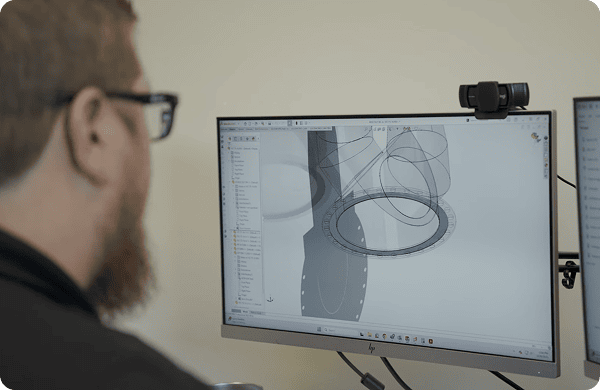
We look at overall geometry to confirm feasibility and review GD&T to ensure design intent matches the requirements. We also review element selection for flexible hose and bellows to achieve the type of flex required for the given application.
02
Production Cost-Benefit Analysis
True DFM identifies where “over-specifying” drives up cost without adding value.
- Tolerance Rationalization: We identify dimensions where, for example, a ±0.005” tolerance performs identically to a ±0.0005” tolerance, significantly reducing tool wear and cycle time.
- Material Utilization: By optimizing nesting and blanking profiles, we’ve historically reduced raw material scrap rates by up to 15% for steel and stainless steel.
From prototypes and First Article parts to small batch runs or full scale production, our DFM analysis will ensure parts are designed as cost-effectively as possible for their intended application without sacrificing quality. For higher volumes and blanket orders, we offer tiered pricing and cost reduction as well as enhanced stability in the delivery schedule. If you’d like to know more, please contact us for more information.
03
Metallurgical Integrity & HAZ (Heat-Affected Zone) Control
Welding is a thermal event that permanently alters the molecular structure of metal and has the potential to create brittle zones. Our DFM reviews prioritize the preservation of material properties through the welding cycle.
- Distortion Prediction: Using proprietary forming data, we can predict, for example, how thin-wall alloys like 304 or 316 stainless steel will “pull” during the welding process. We build compensation into the tooling to ensure the final assembly meets its GD&T (Geometric Dimensioning and Tolerancing) requirements without the need for post-weld straightening or machining, which can introduce residual stress as well as increase cost and manufacturing lead times.
04
Assembly Consolidation & Part Reduction
Every joint, fastener, or weld is a potential leak path or failure point. Our engineering team looks for opportunities to
consolidate multiple components into single, complex fabrications.
- Monolithic design. Where possible, we suggest
transitioning from multi-part weldments to single-piece formed assemblies. This not only reduces the Bill of
Materials (BOM) but also eliminates the variability inherent in
manual joining processes.
05
Tooling-First Methodology
We analyze how your part interacts with our CNC mandrels, laser cutters, or other machines and tooling.
- Springback compensation. For alloys with high elastic modulus, we calculate the exact “over-bend” required. This ensures that the final “relaxed” state of the part matches your CAD model perfectly.
- Access verification. We ensure that every weld joint is accessible for both the torch and the subsequent NDT (Non-Destructive Testing) probes. If you can’t inspect it, you can’t validate it.
Value Engineering (VE): Beyond the First Prototype
While DFM focuses on making the part correctly, Value Engineering focuses on making the part sustainable for the product’s entire lifecycle.
For an example using a hypothetical real-world problem, a design that is technically sound but utilizes a supply chain-restricted alloy or an overly complex assembly process would likely hinder scaling.
For a situation like that, our VE solution would be an analysis of the “Function-to-Cost” ratio to ensure the component can always be readily produced. If a 316L stainless steel assembly with a specific coating performs identically to an exotic Hastelloy build in your specific application, we would recommend the alternative with the more cost-effective and better long-term production capacity. We provide the data to back the pivot, potentially saving 25%–40% in long-term scaling costs.
Technical Capabilities & Software Integration
Engineers need to know that their data is compatible and secure. We maintain a high-fidelity digital thread from the initial STEP file to the final CMM inspection report.

Native software ecosystem
We offer full native support for SolidWorks for 3D modeling and 2D drafting.

AI-enhanced production
We utilize AI in the manufacturing process to optimize quality and production run time. It serves to further enhance weld automation, robotics, and automation in other areas throughout the process.

Rapid Prototyping
We move from digital model to a physical Proof of Concept in accelerated timelines, providing the physical data needed for R&D validation.
The Cenflex Engineering Workflow: From NDA to FAI
Since our founding in 1992, we’ve worked with countless engineers, so we understand the value of structured, repeatable processes. Our workflow is designed to ensure total transparency, drive quality, and protect your proprietary R&D.

Phase 1
Secure IP (NDA)
Every project begins with a robust NDA. Our servers are NIST-compliant, ensuring your proprietary designs and R&D data are protected from external threats.

Phase 2
Technical Discovery
We meet with your team to define Critical-To-Quality (CTQ) dimensions. We don’t just look at the print; we ask about the application’s temperature, pressure, and media compatibility.

Phase 3
DFM Feedback
We can conduct a Production Readiness Review (PRR) prior to production and share cost-saving opportunities and design suggestions. We also offer further suggestions as needed to account for proper flex in the given design.

Phase 4
First Article Inspection (FAI)
We produce a pilot run for your validation. Each FAI is accompanied by a full dimensional report, adhering to ISO 9001 standards.
Once this process is completed, we then begin full-scale production of your part or assembly.
Metallurgical Expertise & Material Performance Data
Choosing the right alloy is a balance of chemistry, physics, and economics. Our staff includes experts in metallurgy who understand how materials behave under extreme environmental stress.
| Alloy Class | Common Grades | Yield Strength (0.2% Offset) | Typical Application |
|---|---|---|---|
| Superalloys | Inconel 625,718 | 60,000–150,000 PSI | Exhaust systems, turbine components, high-heat baffles. |
| Corrosion Resistant | Hastelloy C–276 | 52,000 PSI | Chemical processing in high-chloride environments. |
| Precision Stainless | 316L,17–4 PH | 30,000–145,000 PSI | Medical devices, hydraulic fittings, food-grade assemblies. |
As components are manufactured, we ensure the material properties you require are met. Methods we use include:
- Thermal management. We provide data on the Coefficient of Thermal Expansion (CTE) to ensure your multi-material assemblies don’t seize or leak during thermal cycling.
- Fatigue analysis. For bellows, flexible metal hoses and other components, we provide expected cycle life curves based on hoop stress and meridional stress calculations.
- Work hardening management. We manage the reduction in ductility during forming via interstage annealing, restoring the material properties required for high-cycle fatigue life.
Supply Chain Resiliency & Material Provenance
For CTO’s, the origin of raw materials is a critical risk factor, now more than ever. Project delays due to tier-2 shortages or non-compliance with geopolitical mandates can stall mission-critical R&D.
Cenflex mitigates this risk by offering 100% domestic sourcing options and providing full heat-lot traceability via Material Test Reports (MTRs) for every shipment. By maintaining strategic reserves of steel and stainless steel, we allow your team to bypass standard 16–24 week mill lead times, moving your assembly from design to validation without supply chain friction.
Precision Standards, Compliance & Quality Assurance for Custom Metal Fabrication Projects
Quality isn’t an afterthought; it’s baked into our engineering. We provide the documentation required by R&D managers to sign off on mission-critical components and assemblies. We also alleviate cybersecurity fears with appropriate compliance measures.
- Precision limits:
- CNC Machining: ±0.0005” (0.0127 mm).
- Forming & Fabrication: ±0.005” (0.127 mm).
- Non-destructive testing (NDT):
- Hydrostatic Testing: Capabilities up to 10,000 PSI.
- Dye Penetrant Inspection: Identifying surface-level cracks in critical welds.
- Compliance standards: ISO 9001:2015, ASME Section IX certified welders.
- Full traceability: Upon request, we can provide a Certificate of Conformance (CoC) and Material Test Reports (MTRs) linked back to the original heat lot from the mill.
- Cybersecurity & IP protection: secure, encrypted file transfers and restricted access protocols.
Let’s Solve Your Toughest Engineering Challenge
Don’t wait until the prototype phase to find a manufacturing flaw. Partner with Cenflex for an engineering-first approach to custom metal fabrication and complex metal assembly manufacturing. Take advantage of our comprehensive preliminary DFM review by submitting your files. Our Applications Engineers are ready to discuss your tolerances, material requirements, and production goals.
FAQ: Solving Complex Metal Fabrication Challenges
Is a custom-fabricated manifold more cost-effective than a series of standard off-the-shelf connectors for mid-to-high volume production?
Custom manifolds reduce line-side assembly labor by up to 60% and eliminate multiple potential leak paths, offering a significantly lower total cost of ownership (TCO) than standard fittings in volume production.
How much can I reduce my Bill of Materials (BOM) by consolidating a multi-piece weldment into a single complex fabrication?
Consolidation can reduce a BOM by up to 80% by replacing multi-part weldments with monolithic fabrications, which simultaneously lowers NDT inspection costs and total assembly weight.
What does Cenflex do to protect proprietary R&D designs?
We use secure, NIST-compliant servers and restricted access protocols. Your designs are siloed to the assigned engineering team, ensuring that your intellectual property and competitive advantages are protected throughout the fabrication lifecycle.